July 2018. Gold Coast, Australia. Neeraj Chopra is 20 years old. Outside athletics circles, he’s largely unknown, a kid from Panipat who can throw a javelin unusually far. He steps up, throws 86.47 metres, and wins gold.
Within days, his phone didn’t stop.
Sponsorship calls. Media requests. Government officials. The kind of attention that, the week before, would have been unthinkable.
That’s what a Commonwealth Games medal does for an Indian athlete. Neeraj’s story is just the most visible version of the template. For most athletes in this country who compete in sports other than cricket, a CWG medal is when the system finally notices you.
The money is real, but it’s not the whole picture
The Sports Ministry is direct about it. The CWG payout sits at the same level as an Asian Games medal.
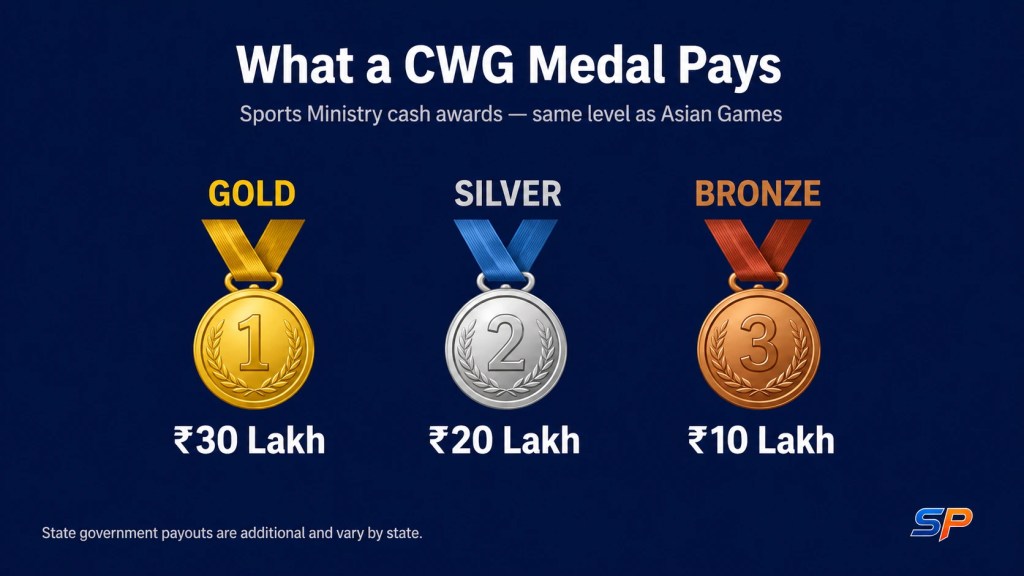
State governments run their own reward schemes on top of this. Haryana has historically been among the more generous: athletes from the state can collect separately under multiple state schemes for the same result. Depending on where you’re from, one medal can unlock a cascade of payouts.
For an athlete who’s been training full time for six, seven years, often without a stable income, often with a family putting money in rather than taking it out, the 10 to 30 lakh isn’t life-changing. But it’s frequently the first time anyone has actually paid them seriously for their sport. That matters more than the number suggests.
The job that changes the equation
Two of the women on India’s lawn bowls team that won gold at Birmingham 2022, Lovely Choubey and Rupa Rani Tirkey, work as a constable and a District Sports Officer in Jharkhand. Both are still active. Still training. Still competing at the national level.
The government job is what makes that possible.
Sports quota positions exist across railways, police services, and government departments specifically because Indian sport needs a way to support athletes who represent the country. After a CWG medal, those conversations happen faster and at a better level.For athletes without family money or private sponsorship behind them, which is most Indian athletes outside cricket, a government salary is financial stability in a way that prize money isn’t. Prize money is a one-time event. A salary is a structure you can train inside.
The visibility that no number captures
Neeraj Chopra’s Gold Coast gold didn’t produce his Tokyo medal. The years of training in South Africa, the elite coaching, the access to biomechanics support, the brand deals that funded a proper setup. Those produced the Tokyo medal.
But all of that came after Gold Coast.
The CWG gold was the moment the machinery started moving in his direction. That’s what the visibility does: it unlocks a support ecosystem that, for most Indian athletes, exists in theory but stays locked until someone in authority has a reason to act.
What the sport cuts cost the athletes who aren’t going
For India’s wrestlers, table tennis players, badminton players, and hockey stars, the CWG was the most accessible podium on the international calendar. The Asian Games and Olympics are harder draws. Stronger fields. Lower medal probability for the same athletes.
The gap is sharpest in wrestling:
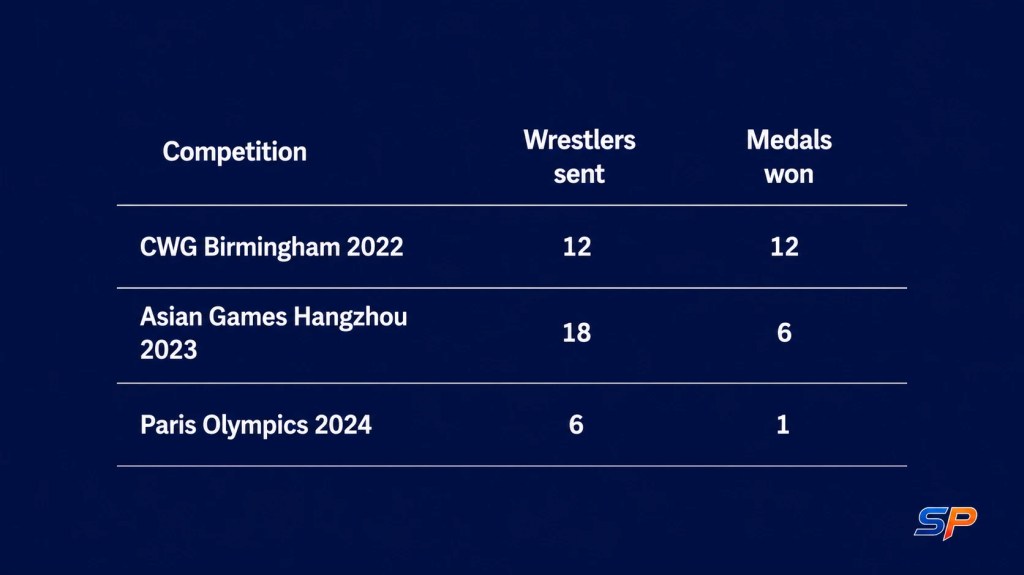
At Birmingham 2022, India’s 12 wrestlers went 12 for 12. Every single one came back with a medal. The CWG wasn’t an easier competition. It was a competition where India’s wrestlers were genuinely dominant in a way they couldn’t replicate at a higher level. That dominance translated directly into medals, government jobs, financial security, and career stability. All of that is gone in 2026 because their sport isn’t in the programme.
The Sharath Kamal success story
- Performance: Achanta Sharath Kamal has won 13 medals over five Commonwealth Games, compared to 2 at the Asian Games.
- The Stage: The CWG provided a platform for him to perform consistently for two decades at a level often out of reach in tougher international fields.
- The Wait: With Table Tennis excluded from Glasgow, he’ll have to wait until 2030 in Ahmedabad.
The financial reality
While the rewards might look similar on paper, the accessibility is vastly different:
- Equal Pay: Both a CWG gold and an Asian Games gold earn Rs 30 lakh from the Sports Ministry.
- Probability: The CWG offered a realistic path to life-changing financial security.
- The Closure: For athletes in cut sports, this reliable path to a career-defining result is closed for 2026.
The age gap and rising competition
The four-year delay to 2030 puts several veterans in a difficult position:
- Prime Years: Stars like PV Sindhu (30) and Bajrang Punia (30) might find the 2030 Games arrive too late for a prime medal run.
- The Alternative: Their main 2026 option is the Asian Games in Aichi-Nagoya.
- The Difficulty Spike: The field in Nagoya is significantly harder, causing India’s medal probability in badminton and wrestling to drop considerably.
Where this leaves Indian athletes
A CWG medal in India serves as three things at once: money, a job, and the moment the system decides to invest in you.
- For those going to Glasgow: That life-changing opportunity still exists.
- For those in cut sports: The wait just grew four years longer. There’s also no guarantee of what the 2030 Games in Ahmedabad will look like.
The unseen impact
We all know the story of Neeraj Chopra’s rise after his 2018 Gold Coast win. However, there are a hundred other versions of that story that go unheard.
Many wrestlers, table tennis players, and badminton stars found their best career windows within the CWG cycle. With these changes, some of them will get another shot at that breakthrough, but many others won’t.
Sources
- India at the Commonwealth Games — Wikipedia
- Commonwealth Games 2026: Cricket, hockey axed — full sports list — Olympics.com
- Avinash Sable may skip 2026 CWG after knee injury — India Today
- CWG 2026 axes nine sports — impact on India — The Bridge
- Top stars face tough road to Glasgow CWG — Rediff / PTI
- Sports ministry cash award guidelines — Government of India
 Sportz Post
Leave a comment